
A Hortus Conclusus: James Stirling’s (1692-1770) Books at Garden
By John Sibbald
The following is a version of a paper given by John Sibbald, a member of the Albertus Institute team, at the Edinburgh Bibliographical Seminar and Workshop: Catalogues and Registers as Evidence in the History of Mathematics, Science, and Technology, Edinburgh University Library, 20-24 July 2026. The conference was supported by the Albertus Institute.
To provide some contextual background, this paper begins with an account of Stirling’s life before turning to the actual contents of his library at Garden, the Stirling family home near Buchlyvie, in Stirlingshire, where his books were from sometime after his death in 1770, until their sale by the firm of Lyon & Turnbull at auction in 2025. The sale catalogue can be viewed at: https://www.lyonandturnbull.com/auctions/books-and-manuscripts-878 Lot numbers are provided for books referred to in the course of this paper. Several of the illustrations are by kind permission of Lyon & Turnbull.
Biographical Note
James Stirling, mathematician and lead mine manager, known as ‘the Venetian’, was born in 1692 at Garden, into the turbulent period following the Revolution of 1688, an event much less than Glorious for many in Scotland, and which saw the brain drain of so much of its intellectual capital to England, and abroad after the Presbyterian ascendancy in the 1690s.
Stirling matriculated at Balliol College, Oxford, in 1711. Oxford, with its strong Royalist traditions, had been an obvious home for many fleeing the newly established Presbyterian Church’s anti-intellectualism. Led by David Gregory, who in 1691 became Savilian Professor of Astronomy, these were early enthusiasts of Newton’s Principia. They were also largely Episcopalians, from similar social backgrounds and kinships in the East and North-East of Scotland.
On arrival at Oxford, Stirling, with his strong Jacobite connections in the East of Scotland, will have found himself amongst friends in what Anita Guerrini calls the “hidden conclaves of Jacobites behind the serene facade of Wren’s Sheldonian Theatre and Tom Tower.” As he wrote to his father, “with the help of my tutor, I escaped the oaths, but with very much ado.”
At Oxford, Stirling’s abilities as a mathematician emerged as early as 1715 in a letter to Sir Isaac Newton from John Keill, a fellow Scot, who had succeeded to the Savilian Professorship of Astronomy in 1712, where he refers to Stirling’s solution of a mathematical problem proposed by Leibniz in the course of the famous calculus controversy between Leibnitz and Newton.
Two years later, while still at Oxford, Stirling published his first book, the Lineae tertii ordinis Neutonianae , the first systematic work devoted to Newton's classification of cubics. That it was published at all is remarkable given the University’s caution over publishing works that might irritate the government. Stirling had been involved in Jacobite riots and deprived of his scholarships, leaving him having to borrow from friends and family, and facing departing Oxford without a degree. Evidence of the power of Oxford’s Scottish diaspora, I would suggest, can be detected here. The book, published by subscription, gathered 181 subscribers, subscribing for 224 copies. 45 subscribers were associated with Balliol. John Baron, the Master of Balliol, who as Vice Chancellor gave the book its Imprimatur, subscribed for 6 copies, as did John Keill. Newton himself subscribed for 2.
As for the lack of prospects, I think we see the Scottish diaspora again coming to the aid of one of their own. The book, instead of being more obviously dedicated to Newton, is dedicated to the Italian ambassador Nicolo Tron, with whom Stirling then departs to Venice with the possibility of a mathematical post, presumably at Padua: possibly even the post contemplated earlier by John Keill, when his first attempt to gain the Savilian chair failed.
Although the post didn’t materialise, Stirling continued in Venice for several years where he assisted Tron in the management of his coal and china clay mines in the Veneto, gaining knowledge that would stand him in excellent stead in the second half of his life at the lead mine at Leadhills. Despite his probably straightened circumstances, a copy of the Bible printed in Venice in 1603[L&T 131] which has his signature, date of purchase 1720, and price of 22 Venetian lire, would suggest that Stirling was still managing to buy books there.
By 1725 we find him in London, employed as a tutor at Watts’s Academy in Little Tower Street. This had been opened earlier by the mathematician and entrepreneur Thomas Watts. Stirling delivered lectures on Newtonian topics, providing a course of mechanical and experimental philosophy.
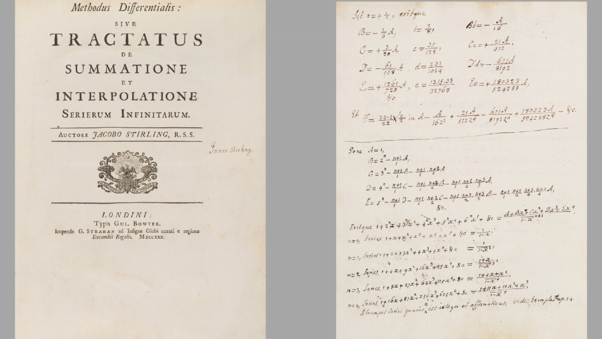
In 1730, he published his principal contribution to mathematics, the Methodus differentialis,[L&T 53]– the above is Stirling’s own copy, one of 26 on large paper, with his signature on the titlepage and replete with his annotations and corrections. Now regarded as one of the early classics of numerical analysis, it contains the contributions for which Stirling continues to be remembered: the Stirling numbers and Stirling’s formula to estimate large factorials.
Proposed by Newton, Stirling had been elected to the Royal Society in 1726. On the introduction of John Arbuthnot, another member of the Scottish diaspora, Stirling became one of the brilliant coterie around the politician and diplomat, Henry St. John, Viscount Bolingbroke in its sustained intellectual attack on Walpole: Stirling being thought to be one of the few capable of understanding the financial calculations of the Prime Minister. There were works in the library by Bolingbroke as well as others connected with his circle such as Pope, Swift, and Gay.
Over the summers of 1734 to 1736, probably at the suggestion of Watts who was a shareholder, Stirling became employed as manager at the Scotch Mines Company at Leadhills in Lanarkshire, at that stage almost bankrupt. In 1737, he moved there permanently until his death in 1770, working as the Company’s chief agent and returning the mines to prosperity.
Translating into reality the Enlightenment’s desire to bring science to support social improvement, Stirling worked hard to improve both the working and living conditions of his miners, including founding Britain’s oldest subscription library and the world’s first library for working men. His success is seen now as a step towards the progression of workers’ rights and modern social security, and as one of the most extraordinary operations of the British Industrial Revolution.
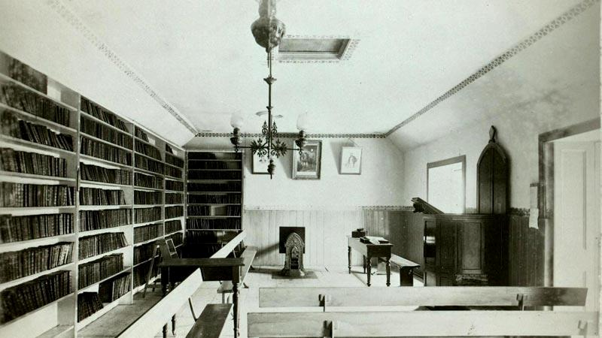
The Leadhills Miners’ Library interior
Books
Turning now to the library at Garden, you will look in vain for any reference to it in entries on Stirling in the standard scientific encyclopedias. You will find no mention of it in Stirling’s biography in either edition of the ODNB. Charles Tweddie, Stirling’s principal biographer, believed only two of Stirling’s books survived. The library appears simply to have been, not so much ‘conclusus’, as actually invisible.
It is not always clear which books belonged to Stirling rather than to other members of his family. He did not use a bookplate or sign his books as standard practice. The Lyon & Turnbull sale catalogue records only 21 works with his initials or signature. Less than a dozen books have been identified with annotations by him. There is no other discernible common physical evidence of Stirling’s ownership such as Newton’s habit of dog-earing pages.
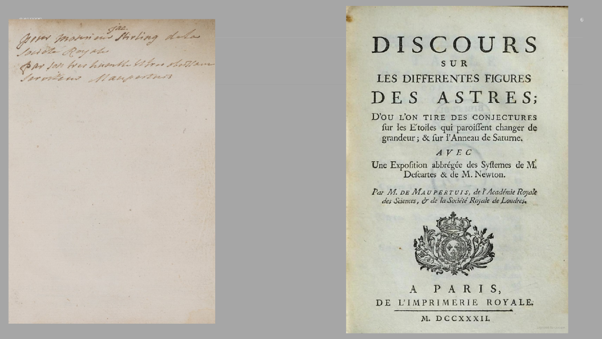
Clearly his are the many presentation copies he received from both British and foreign mathematicians. The above illustration shows a presentation copy from Pierre de Maupertuis, the author’s first book and the first Newtonian treatise published in France [L&T 56], with its friendly inscription, despite the author’s unflattering view of Stirling’s Methodus which he called “the most disagreeable thing in mathematics”.
Books most likely to have been his because of their subject matter include Vitruvius’s De architectura published in Lyon in 1552, [L&T 87], an author on whom Newton relied heavily in connection in his attempts to reconstruct the measurements of Solomon’s temple. Another would surely be the Archimedes (Paris 1615), whose work on integration gave birth to the calculus of the infinite, brought to perfection by Leibniz and Newton [L&T 83]. Authoritative in its day - Newton also owned a copy - it subsequently became notorious for its interpretive errors. For similar reasons these handsome editions of Newton’ friends, Plato and Aristotle are likely to have been Stirling’s. (“Amicus Plato — amicus Aristoteles — magis amica veritas. Plato is my friend — Aristotle is my friend — but my greatest friend is truth”). In the case of Plato, the magnificent edition printed at Geneva by Henri Estienne in 1578, and that of Aristotle at Paris in 1619. [L&T 79 & 80]
Typical of libraries of this period are the numerous works of classical authors, theology and church history. More than a quarter of Newton’s books were on similar subjects. Newton drew on these sources for his research into gravity and other revisions he proposed to the Principia in the 1690s, but more significantly for the years immediately after the publication of the Principia his main focus was on Biblical exegesis, with most of the rest of his life immersed in theological research. Stirling will have studied such works for similar interests though again there are only a few volumes confidently identifiable as his. However, unlike Newton, there is no evidence to suggest that Stirling spent most of his life immersed in theological research. Books in the Garden Library on measurements, weights, currency and coinage also reflect further interests shared with Newton and his and Stirling’s contemporaries.
Probably Stirling’s too are works by Hume and Ferguson, and the first Scottish edition of 1750 of Montesquieu’s De l’esprit des loix, for which Montesquieu had supplied Hume with corrections. [L&T 125, 127, 128, & 98] The author’s emphasis on what the state owes its citizens by assured subsistence, nourishment, suitable clothing, and a life free from extreme deprivation surely cannot have escaped Stirling’s notice - they are the very provisions made by him for his miners at Leadhills.
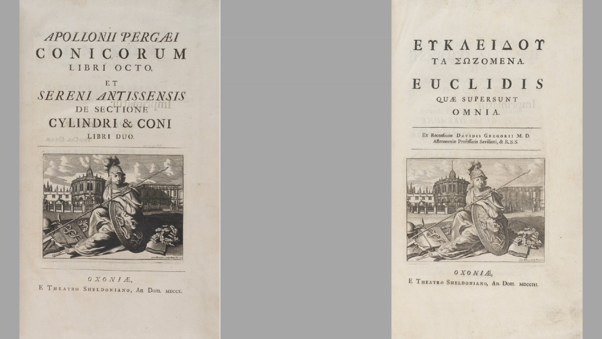
With his fondness for expensive works and large paper copies, Stirling emerges as something of a bibliophile. Amongst these are Edmond Halley’s edition of the Conics of Apollonius (1710), a tall copy which set the Oxford student back £1.7s. [L&T 39]. David Gregory’s edition of Euclid, like the Apollonius, another fine product of the Oxford press, is one of 250 copies on large paper. [L&T 40]. Stirling’s copy of the third edition of Newton’s Principia (1726), the last edition edited in Newton’s lifetime, and with a new preface and numerous alterations made by the author, is one of 200 copies of the more expensive issue on larger paper. In letters home from Oxford, he portrays himself as trying to keep down expenses. He complains that “Every Thing is very dear here. My shirts cost me 14 shillings a piece”. Evidently his efforts at economy did not include his book purchases.
Conclusion
As well as providing information about Stirling’s intellectual and other interests, his books provide considerable insight into the material and social context of the exchange and development of ideas in the Early Scottish Enlightenment, the parts played by social and intellectual networks, the availability and circulation of books and articles, and learned societies of which Stirling was a member of the Royal Society, the Edinburgh Philosophical Society, and held a diploma from the Royal Prussian Academy of Sciences. His books, along with his Ms. notebooks, and correspondence with European mathematicians such as Gabriel Cramer, Nicolaus Bernoulli, Leonhard Euler, and others, clearly support the conclusion by Niccolo Guicciardini that, of British mathematicians, it was Stirling who had most contacts with the continent.
Unlike his miners’ library, there are no contemporary lists or catalogues of Stirling’s own books. Our chief records are the much later shelf list at Garden compiled by the late Sir James Stirling in 1986, and the Lyon & Turnbull sale catalogue, which inevitably concentrates on the more high-end items and does not claim to be an exhaustive list.
And now, without even the books on the shelves, we shall have to rely on other sorts of information, and the way in which James Stilring’s previously invisible library can now be represented, studied, or analysed. No longer a ‘hortus conclusus’, more a ‘hortus apertus’.
